
Welding safety: Protecting everyone in the room
WELDING HAZARDS extend beyond the welder. Effective protection safeguards everyone working nearby from sparks, radiation and fumes, says Scott Fullerton.
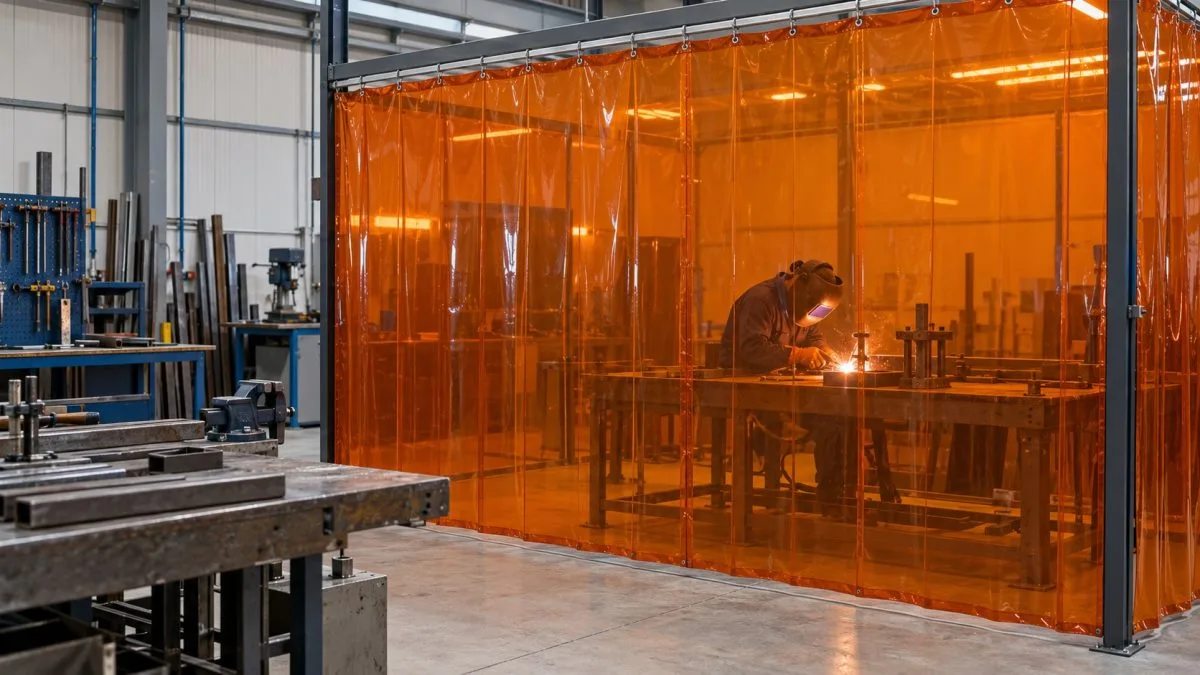
Welding safety conversations usually focus on the welder: the mask, the gloves, the extraction arm. That focus is right, but it leaves a gap. In most fabrication shops, maintenance workshops, and production facilities, welding does not happen in isolation. Other people work, walk, and store materials within metres of the arc, and they face hazards they have not chosen and are rarely equipped for.
Three hazards that travel
The first is arc radiation. Ultraviolet and intense visible light from the arc can cause arc eye and skin burns in anyone with a line of sight, not just the welder. HSE’s guidance on controlling the risks from welding points to screens and curtains between the arc and nearby workers, and the relevant product standard is BS EN ISO 25980:2023, which covers transparent welding curtains, strips, and screens. Not every clear curtain meets it, so ask for evidence of conformity.
The second is fire. Spatter, sparks, and hot slag can travel well beyond the work area and ignite packaging, stored materials, or dust. In buildings where hot work shares space with other activity, uncontrolled spatter is a genuine fire and evacuation risk, not just a housekeeping issue.
The third is fume. Since HSE reclassified mild steel welding fume as a carcinogen in 2019, the expectation has been clear: fume must be controlled at source, typically through local exhaust ventilation. A curtain does not replace that. What segregation can do is reduce the number of people working close to the source, which is a sensible part of the wider control plan.
 Segregation as an engineering control
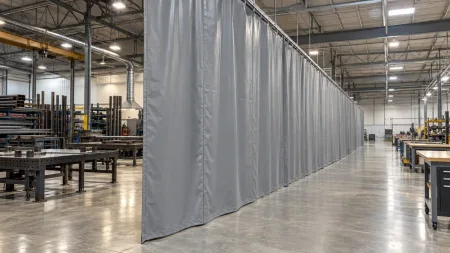
The practical answer to all three is the same: give welding its own defined space. Properly specified welding curtains create a physical boundary that blocks arc light from neighbouring areas and contains spatter within the bay. For larger operations, industrial curtain walls can separate an entire fabrication zone from assembly, storage, or circulation routes, and can be repositioned as layouts change, without the cost or disruption of permanent construction.
Getting the specification right
Three points matter most. First, match the product to the job. Arc light screening is covered by BS EN ISO 25980, while fabric flammability for curtains is covered by BS 5867 Part 2 Type B, with a BS EN 13501-1 Euroclass rating where the application requires it. These are different tests for different hazards, and a credible supplier should be able to show certification for each claim. Second, keep escape routes clear. Under the Regulatory Reform (Fire Safety) Order 2005, any partitioning must be coordinated with the fire risk assessment so it never obstructs exits, fire detection, or sprinkler coverage. Third, inspect and maintain. Damaged, scorched, or gapped curtains lose their effectiveness quickly, so include them in routine workplace inspections.
A wider view of welding safety
Protecting the welder will always come first. But a safe welding operation is one where the people around it are protected too. Clear segregation, the right certified materials, and partitioning that respects the building’s fire strategy turn that principle into something practical.
About AKON Curtains Limited
AKON Curtains Limited supplies welding curtains, welding screens, and industrial PVC partitioning across the UK, Ireland, and broader European markets. Drawing on operational experience from its US parent group’s installation base and 15 years of industrial PVC specifier expertise, AKON Curtains Limited helps safety and operations teams separate hazardous processes safely.
Scott Fullerton is operations manager at AKON Curtains Limited. For more information, visit akoncurtains.co.uk.
HSM Newsletter
HSM publishes a weekly eNewsletter, delivering a carefully chosen selection of the latest stories straight to your inbox.
Subscribe here