


Call for urgent action on silica exposure
AT TUC Congress, Thompsons Solicitors called for a UK-wide ban on engineered stone and wider action to protect workers from silica exposure, warning that serious failures uncovered by Health and Safety Executive (HSE) inspections demonstrate the need for urgent intervention.

The firm joined forces with Unite the Union to host Silicosis, Engineered Stone and the Fight for Safer Workplaces fringe event in Brighton on 15 September, bringing together legal, trade union and occupational hygiene experts to discuss the growing risks from exposure to respirable crystalline silica (RCS).
The event came just months after the HSE launched its most significant intervention to date in the engineered stone sector, publishing its first dedicated COSHH guidance for the material and beginning a programme of more than 1,000 inspections across Great Britain.
The new guidance makes clear that dry cutting is unacceptable and sets out measures businesses should have in place to control exposure to silica dust, including using lower-silica stone, on-tool water suppression, appropriate respiratory protective equipment and regular health surveillance.
HSE research found that dry fabrication typically produces RCS exposure five to ten times higher than wet methods using equivalent tools.
But enforcement action since the programme began has already identified workplaces where those protections have not been in place. HSE notices have included failures relating to water suppression, respiratory protection, extraction and health surveillance.
Thompsons said the findings demonstrate the severity of the issue and raise a fundamental question about whether an approach dependent on workplace controls being correctly applied on every job and every shift can provide sufficient protection.
At the TUC event, the firm called for a UK-wide ban on engineered stone, alongside:
- improved screening and health surveillance for workers who have already been exposed to silica dust;
- silicosis to become a standalone reportable occupational disease under RIDDOR;
- stronger reporting and enforcement to identify where workers are being put at risk; and
- greater awareness and action on silica exposure across industries beyond engineered stone.
Thompsons’ call for standalone reporting of silicosis was also included in its response to the HSE’s recent consultation on reforming workplace injury and disease reporting.
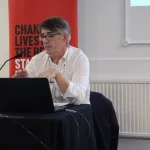
Daniel Poet, partner, Thompsons Solicitors, said: “The HSE has strengthened its guidance and stepped up inspections of businesses working with engineered stone, but the serious failures already being uncovered only serve to reinforce why we believe managing the risk is not enough.
“Silicosis is irreversible. Once the damage has been done, it cannot be undone. We should not accept a system that continues to expose workers to that risk when the hazard can be removed altogether.
“Inspection and enforcement are important, but controls can fail. Eliminating the hazard does not. That is why we are calling for a UK-wide ban on engineered stone.
“Day in, day out, we see first-hand the devastating consequences when employers fail to control known risks and workers are made seriously ill as a result. We also have to act for those who have already been exposed. A ban cannot undo years of breathing in silica dust.
“We need effective screening and health surveillance to identify disease earlier, alongside better reporting so we understand where exposure is happening, who is becoming ill and where intervention is needed most.
“But this cannot stop at engineered stone. Silica is a serious occupational hazard across a range of industries. The attention on engineered stone must be used to drive greater awareness, better protection and stronger action wherever workers are being exposed.
“We know from the people we represent what happens when protection comes too late. We need to support those already affected and take decisive action to prevent more workers suffering the same harm.”
Tina Conroy, Chartered Occupational Hygienist and Technical Director at Pragma and Associates, shared what she and fellow occupational hygienists are seeing on the ground, including increasing silica-related concerns outside the engineered stone sector.
She said the focus on engineered stone appears to be increasing awareness of silica exposure more widely, helping to shine a light on risks in other industries where workers may be exposed to dangerous levels of RCS.
Thompsons said the experience reinforces the need for action beyond engineered stone, with silica exposure posing a risk across construction, quarrying, brick and concrete production and other stone-processing industries.
The event also heard from Jason Poulter, National Officer for Construction at Unite the Union, who said: “Unite members continue to be exposed to deadly silica dust leading to premature deaths as employers fail to protect their workforce.
“We are proud to join industry and professionals to support construction trades exposed to silica dust and we stand by our call for a ban on engineered stone and strict dust limits. We are also clear on the need for government legislation to extend the role and influence of union safety reps in defending workers across our industries. No kitchen worktop is worth a worker’s lungs.
“No product is worth a worker’s life. And no family should have to pay the price for someone simply going to work.”
The discussion was chaired by Huma Haq, Health & Safety Lead at the TUC.
HSM Newsletter
HSM publishes a weekly eNewsletter, delivering a carefully chosen selection of the latest stories straight to your inbox.
Subscribe here