

When loud becomes liability
THE TRANSITION from a productive environment to a hazardous one is often a matter of decibels that go unmeasured. Tim Turney explains the critical importance of robust monitoring and the risks of non-compliance.

The health and Safety Executive (HSE) estimates that more than 2 million people in Great Britain are exposed to unacceptable levels of noise at work with noise-induced hearing loss, the second most common reason for employers’ liability insurance claims for occupational health.1
Workers with affected hearing are up to five times more likely to develop dementia, suffer from social isolation, have weakened processing abilities and are at a higher risk of physical injury due to a lack of awareness of immediate hazards.
Workforce protection
When noise in a workplace is present, employers need to take action to reduce noise exposure, provide noise control measures as well as personal hearing protection for any residual risk. The UK enforces good employer practice through the Control of Noise at Work Regulations 2005. This means the emphasis is on control of noise, through the hierarchy of control, employers must provide hearing protection when noise exposure cannot be controlled through other means to protect from residual risk.
Employees must have personal hearing protection made available to them at 80dB(A) and must wear hearing protection at the next action level of 85dB(A). This assumes that the correct hearing protection is effective, correctly fitted, worn at all times and maintained in good condition.
When to act
For noise control, a survey should be conducted to identify the sources and determine their contribution to the area noise level and worker noise exposure, so that businesses can identify at-risk employees and ensure they adhere to regulations. However, professionals undertaking the monitoring must be trained and prepared with the right equipment as errors in noise level measurements can lead to errors in exposure calculations. This results in greater risks for employers and employees’ long-term ear health.
Noise survey equipment
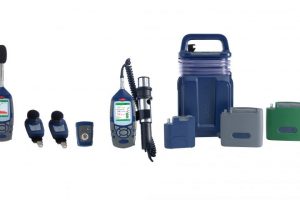
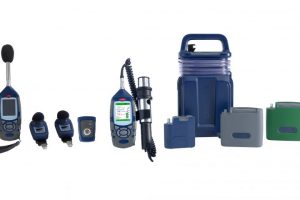
There are two main types of equipment: sound level meters (SLMs) and noise dosimeters. Using a combination of both SLMs and noise dosimeters is recommended to establish a clearer picture.
Sound level meters are handheld devices, ideal for spot measurements of noise at specific locations or tasks, held up to the ear pointing at the noise source. They are also ideal for commissioning new equipment, diagnosing hotspots, comparing alternative alarm types, or validating the effect of engineering controls like barrier mats or dampers.
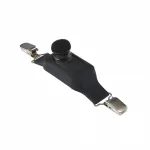
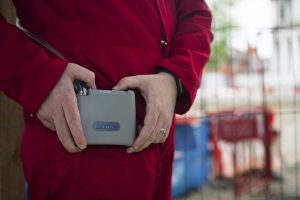
Noise dosimeters, on the other hand, serve a purpose by measuring personal exposure over a full shift. Tasks in logistics, construction or manufacturing, for example, are by their nature more mobile, so a bodily worn device will be the best way to monitor personal exposure. They account for worker movement, task variation and breaks, providing a realistic time-weighted average for specific roles that can then be compared to action values.
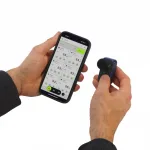
To use dosimeters effectively, position the microphone in the hearing zone near the shoulder, ensuring it is unobstructed by clothing or PPE. Modern noise dosimeters are often easy to set up and can stream real-time data directly to an employer’s phone or tablet, so that readings can be checked remotely through the day without disturbing the wearer.
Implementing these learnings
Once the levels of sound are understood across the facility, noise mitigation strategies can be implemented that follow the hierarchy of controls. At the source, employers can look to reduce the noise from its source, like in machinery or equipment. Opting for low-noise wheels and tyres for material handling equipment, specifying quiet conveyor rollers or other sound-dampening tools can all reduce total noise output. It is often recommended to install barriers and a sound absorber around particularly noisy static machinery as well.
Administrative controls can then minimise exposure by scheduling noisy tasks away from busy areas, creating quiet zones for precision work, and structuring maintenance windows outside of peak hours to confine noisy activities. Engineering noise controls can often be inexpensive, whereas there may be a perception that cost will be high. There are firms that specialise in industrial noise control that can help.
The last line of defence: PPE
PPE should always be the final refuge for employers once all engineering controls and administrative controls have been considered. Hearing protection should be selected that matches the noise profile without over-attenuating, as this can lead to unnecessary accidents where employees miss sound cues from vehicles or warnings from colleagues. Being struck by a moving vehicle is the second most frequent cause of workplace fatalities, according to the HSE, so awareness of surroundings is vital.
Employers can take a proactive approach to encourage all-day wear by considering comfort and effectiveness as a priority. Strong communication around the need and considering the environment, the individual, and the relationship with other personal protective equipment (PPE) is also important.
Removing PPE, even for short periods, has a significant effect on exposure. Therefore, it is crucial that hearing protection is comfortable to increase worker acceptance and support the likelihood of all-day wear. When working in an environment with airborne hazards present, for example, employers should ensure the hearing protection provided is comfortable and unobtrusive to the respiratory protection worn. The interaction of hearing protection with other PPE is also a significant factor. For example, an employee wearing prescription or safety glasses may not obtain an adequate fit from a standard earmuff, so plugs or semi-inserts may be more suitable.
Sound management
Ultimately, the transition from ‘loud’ to ‘too loud’ is often only identified when irreversible damage has already occurred. For UK employers, the Control of Noise at Work Regulations (2005) provide the framework, but the true measure of success lies in the proactive integration of monitoring technology. By utilising a dual approach, combining the precision of sound level meters with the real-world data of wearable noise dosimeters like the Casella OmniWear Noise, businesses can move beyond guesswork to evidence-based safety strategies.
Protecting a workforce from NIHL is not solely about the provision of PPE; it is about fostering a culture where monitoring is continuous and the interaction between various forms of protection is meticulously managed. In an era where occupational health is under increasing scrutiny, failing to monitor noise accurately does more than risk a liability claim; it jeopardises the long-term cognitive and physical well-being of the people who drive the business forward. Investing in the right tools today ensures that ‘too loud’ never becomes the workplace standard.
Casella is dedicated to reducing occupational health and environmental risks and supporting businesses in solving their monitoring and analysis needs.
Tim Turney is global marketing manager at Casella. For more information, visit www.casellasolutions.com.
Reference
1 https://www.hse.gov.uk/treework/health/noise.htm
Related posts
HSM Newsletter
HSM publishes a weekly eNewsletter, delivering a carefully chosen selection of the latest stories straight to your inbox.
Subscribe here