


To HAV and to hold
The HSE estimates that up to two million workers are exposed to levels of vibration that could result in
ill health. With several solutions for managing Hand Arm Vibration exposure available, Jim O’Hagan
considers the optio
The HSE estimates that up to two million workers are exposed to levels of vibration that could result in
ill health. With several solutions for managing Hand Arm Vibration exposure available, Jim O’Hagan
considers the options and makes the case for deploying an automated solution
The main regulations that govern
the management of HAVs are the
European Union’s Physical
Agents Directive and the UK’s Control of
Vibration at Work Regulations. Central
to these Regulations are the hand arm
vibration exposure action-value (EAV)
and exposure limit-value (ELV). The
EAV may be described as a level of daily
vibration exposure, that if exceeded,
requires the employer to introduce
control measures such that exposure is
reduced to a level as low as reasonably
practicable. The ELV may be described
as a level of daily exposure that by law
must not be exceeded.
Key to these values is what is termed
‘A(8)’. This is a unit that might
conveniently be described as representing
a ‘dosage’ of vibration exposure, over an
assumed ‘typical’ eight hour shift.
The EAV is equal to an exposure of
average vibration magnitude of 2.5 m/s2
for a total period of 8 hours in a working
shift.
The ELV is equal to an exposure of
average vibration magnitude of 5m/s2 for
a total period of eight hours.
There are several solutions available to
help manage Hand Arm Vibration
Exposure ranging from paper based
solutions to fully automated management
solution, these include:
Tool labelling
Some organisations fit green, orange or
red plastic or water resistant labels to their
power tools that are pre-printed with
vibration data and the maximum amount
of time that an operative can use that
particular tool before reaching their EAV
or ELV level. The onus is then on the
operator to ensure they do not exceed the
recommended time.
Manual records
Other organisation rely on their operative
to report on a daily basis what tools they
used and for how long in a manual
“school jotter” type document. Ideally this
data should be captured at the end of the
shift prior to the operator leaving site.
Individual Dosimeter
There are commercially available
dosimeters that provide a traffic lights
system to alert the operator when EAV
and ELV levels are met. The operator
programmes the dosimeter and fits it in
turn to each of the tools used throughout
the shift. Prior to using the dosimeter on
each tool the operator has to:
1. Determine the vibration level of that
tool by referring to its manual
2. Programme that into the dosimeter
3. Fit the dosimeter to that tool
Fully automated solution
Although the above methods are widely
used, they have limitations. For example
labels can get damaged and become
unreadable, or are even lost and not
replaced, and manual methods are often
inaccurate unless they are strictly
monitored. However there are several
technologies available today that can be
deployed to create an automated solution
that can achieve the following:
Easy to use
Minimise operator interaction
Accurately measure trigger time
Provide a real time display of actual
exposure points in line with HSE
recommendation
Give visual traffic lights to immediately
alert the operator
Require no programming by the
operator
Collate and gather operator exposure
data automatically
Generate useful management
information
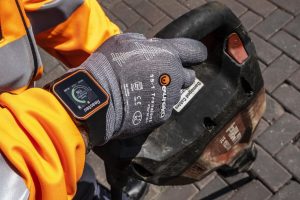
The HAVmeter from Reactec for
example, is a solution that delivers the
above benefits. The HAVmeter can
calculate and record cumulative real-time
vibration data across all vibratory hand
tools in use by an operator throughout the
working day. Each power tool is fitted with
an RFID tool tag that contains basic asset
data and average vibration level. A personal
swipe card enables the operator to swipe
out a HAVmeter from a base station. The
HAVmeter magnetically attaches to the tool
tag and “connects” with that tool data. The
operator moves the HAVmeter from tool
to tool throughout the working day and
returns the HAVmeter to the base station at
the end of the working day, at which time
the data for the tool usage is transferred
automatically to the Basestation. The data
on the Basestation is stored on a memory
card for upload into a comprehensive suite
of reporting software that provides detailed
and accurate analysis of operator exposure
records. The data collected enables
management to completely automate
reporting, identify staffing issues on
particular jobs and help protect the
company from false claims. Companies that
see the system as a management tool rather
than just a health & safety device can see a
return on investment well with 12 months.
Jim O’Hagan is the managing director of the
HAVmeter division, Reactec. Visit Reactec,
Stand 240 at Health & Safety ’10 North
Related posts


HSM Newsletter
HSM publishes a weekly eNewsletter, delivering a carefully chosen selection of the latest stories straight to your inbox.
Subscribe here