
Meeting the demands of bariatrics and expectant mothers
Changes in social trends pose new challenges for
business evacuation plans, explains Mark Wallace
One of the consequences of the
economic downturn has been an
unprecedented rise in pregnancy
rates, with the demand fo
Changes in social trends pose new challenges for
business evacuation plans, explains Mark Wallace
One of the consequences of the
economic downturn has been an
unprecedented rise in pregnancy
rates, with the demand for pregnancy
tests having increased by 31 per cent
since the onset of the recession. Obesity
levels are also on the increase with
almost a quarter of adults in England
classified as obese. These changing social
trends have an impact on a range of
businesses and services, not least the
health and safety sector.
Businesses may keep abreast of social
trends through their work to help increase
revenue and make relevant and targeted
business decisions, but they should also
consider how these trends may impact on
the day-to-day running of their business
and in particular their impact on
emergency evacuation plans.
With pregnancy rates around 2 per
cent higher than they were back in 2007
when the credit crunch hit, it is
increasingly likely that a business is
employing an expectant mother.
However, whilst many employers are fully
aware that the evacuation plans of
employees with walking difficulties need
to be considered, the needs of pregnant
employees and visitors are often ignored.
Risk assessments for expectant
mothers
Employers not only have a duty of care,
they are legally obligated, under the
management of health and safety at work
regulations of 1999, to carry out a full risk
assessment of expectant mothers. For a
woman experiencing mobility
difficulties, which is usually in the third
trimester, this should include a personal
emergency evacuation plan for that
individual. Employers should ensure that
pregnant women are not exposed to any
significant risks and that any known risks
are quickly mitigated. For women who
struggle or are slow at negotiating
staircases in an emergency, appropriate
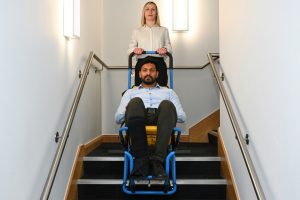
equipment such as an evacuation chair
should be provided and those individuals
who operate the chair need to be
adequately trained to assist the individual,
as this is essential to help pregnant
women make a safe and swift evacuation.
Some employers may be unaware that
it is no longer the responsibility of the
Fire Service to evacuate persons from a
building and businesses should not rely
on their intervention. The Regulatory
Reform (Fire Safety) Order 2005 instead
places a legal duty on those individuals
with responsibility over the management
and operation of the premises to provide
adequate means of escape in the event of a
fire for all building occupants – not just
their employees.
Meeting the demands of the
bariatric market
Therefore, businesses may also need to
consider their provision for those leading
another social trend –
obesity. The pressures
on the healthcare sector
in the UK and its need
to develop specialist
equipment for the
bariatric market,
such as ambulance
stretchers, has
been well
publicised. But
with obesity
levels at an all
time high
and set to rise, the need to provide
evacuation equipment for bariatric
employees and visitors is crucial.
For many companies, buying a product
such as an evacuation chair enables them
to fully comply with certain legislation.
Recognising the need to review its
products to ensure these individuals are
catered for, Evac+Chair International has
invested significantly in research and
development and has recently launched
an evacuation chair which will easily cater
for a heavier weight capacity of up to
200kg. We have also modified our
standard chair to handle a payload of
180kg – an increase of 30kg on the earlier
model.
In recognising that some employees
and visitors may have special
requirements in an evacuation, it will only
serve to make them confident that they
will be safer in an emergency. Businesses
should be proactive and aware of the
changes in social trends that face them
today. It may seem like a challenge to
review their evacuation plans, but by
being aware and flexible to the needs of
expectant mothers and obese individuals,
as well as the disabled and mobility
impaired, employers can be sure that they
are complying not only with legislation
and have peace of mind that the needs of
all people on the premises in event of an
emergency will be met and satisfied.
Mark Wallace is managing director of
Evac+Chair International
Related posts

HSM Newsletter
HSM publishes a weekly eNewsletter, delivering a carefully chosen selection of the latest stories straight to your inbox.
Subscribe here