
Building the way to safety on site
David Lummis, CEO of the British Safety Industry Federation (BSIF), discusses health &
safety in the construction industry and the varying attitudes to the topic.
According to statistics from the HSE, in 2009/10 the
co
David Lummis, CEO of the British Safety Industry Federation (BSIF), discusses health &
safety in the construction industry and the varying attitudes to the topic.
According to statistics from the HSE, in 2009/10 the
construction industry had one of the highest rates of
reported fatal injuries – 30 deaths – compared to any
other main industry group. Additionally in 2009/2010, it was
reported that 2 fatal injuries, 407 non-fatal injuries and 864
over three day injuries happened to individuals working in the
construction industry because they were hit by a moving, flying
or falling object.
Due to the very nature of the work, the construction industry is
fraught with dangers; consequently minimising the risk of
‘foreseeable’ accidents and putting adequate prevention methods
in place will go a long way to help reduce injuries in this sector.
In building construction work there are inherent dangers,
particularly as structures are in a partially completed state for
long periods of time. Additionally, all manner of tools and
equipment are on site, materials are stored ready for use and
dangerous waste materials are generated. Combine these with an
ever changing workforce during the period of the build and each
of these presents a hazard to the safety of the site personnel and
the general public (if the site is close to public access areas).
Ultimately, the legal responsibility for health & safety sits with
the contractor/owner of the site. To ensure safe working
practices, a good attitude to safety by all site personnel must
exist. Creating a safe working environment requires that in
addition to any formal rules of conduct, workers must be kept
aware and informed of the continually changing dangers of the
site and the hazards that exist in their particular job roles –
health & safety needs to be everyone’s responsibility.
An example of an accident that took place during the
construction of a residential property was when a labourer fell three
metres down a temporary stairwell after a colleague had removed
the guardrail. Consequently the labourer fell nearly three metres
to the landing below; he suffered two broken ribs and a bruised
kidney and he was unable to return to work for three months
owing to his injuries. Consequently, the company appeared at
Edinburgh Sheriff Court on 27 July and pleaded guilty to breaching
reg.4 of the Work at Height Regulations 2005 and was fined £8000.
While substantial improvements have been made in
construction health & safety since the 2001 Construction Summit,
needless deaths and injuries still occur. The construction
industry needs support and encouragement to ensure continuing
improvements are made. While the industry must be
congratulated on what has been achieved – we must not lose sight
of continuing failures. These failures could be addressed by a
change of mindset – the workers, contractors and general public –
if this change is backed up by some simple common sense actions,
then numerous lives could be saved and injuries prevented.
To change these attitudes it is vital that those who need to set an
example are doing so. It was disheartening to learn that recently
a leader of a London council refused to wear a hard hat while
visiting a redevelopment site in his borough, saying “people should
have a choice whether to wear them or not.” According to a local
newspaper, Councillor Carr refused to abide by health & safety
rules when being shown the progress of building work at The
Pavilion leisure centre in Bromley as part of a group. Before entering
the site, the construction firm’s site manager handed out highvisibility
jackets and hard hats and everyone put on the personal
protective equipment (PPE) except for Councillor Carr, who
refused to wear the hat. Once inside the site – where all workers
have to wear a hard hat – the manager asked Councillor Carr why
he was not wearing one, to which he replied: “I don’t do hats”.
Challenging attitudes
This blatant disregard by Councillor Carr for construction health &
safety rules is extremely disappointing as he should be leading by
example. While I read that as a consequence, the site manager led the
team around ‘a safe zone’ of the site, this story nevertheless highlights
the inflexibility of the councillor in question. Whilst health & safety
professionals, together with construction workers, continue to strive
to reduce serious accidents on sites, his attitude highlights what is
unfortunately probably not an isolated attitude. A serious attitude
change towards health & safety is needed. Surely he is aware that the
instances of death and injury can be considerably reduced by the
provision and wearing of good quality PPE?
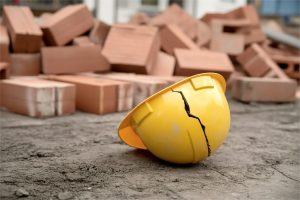
With regards to hard hats, in theory, common sense should
dictate that this is an essential piece of PPE in construction as there is
a constant risk of moving, flying or falling objects. While legislation
may dictate that site contractors need to minimise the risks
associated with working on sites by providing the necessary PPE, at
the same time an individual should be willing to protect themselves
by readily wearing such equipment, without being forced to do so.
After all, jockeys would not participate in a horserace without
wearing a riding hat, so why should individuals not wear a hard hat
on a construction site that has been appropriately risk assessed?
Each year too many construction workers are needlessly
injured or killed while working on site. Whilst improvements
have been made in recent years there needs to be continuing
effort to increase awareness of health & safety in the UK
construction industry in an effort to prevent needless accidents
and deaths at work. Employers and employees, together with
upstanding members of the community, need to join forces to
present a positive image
towards health & safety.
Related posts

HSM Newsletter
HSM publishes a weekly eNewsletter, delivering a carefully chosen selection of the latest stories straight to your inbox.
Subscribe here