
Warehouse accidents fall 10%
HEALTH AND Safety Executive data reveals a 10% fall in warehouse accidents since 2021, but slips, trips and falls remain the leading cause of injury in warehouse settings.
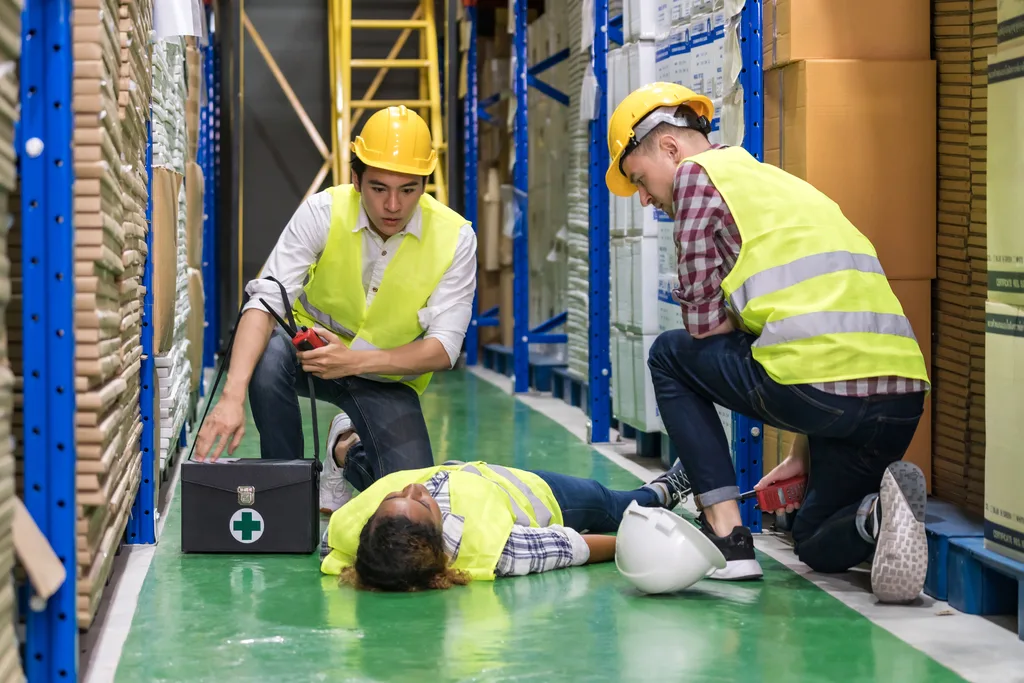
Major warehouse employers have been under scrutiny to implement additional safety measures to protect workers from harm after reports of illnesses and injuries related to their work. Under the Management of Health and Safety at Work Regulations 1999, employers are required to produce thorough written risk assessments and implement proactive safety management systems.
Despite comprehensive regulations surrounding best practices, accidents and injuries happen on a daily basis, with Bureau Veritas revealing that around 10 accidents per day take place in warehouse settings.
Bureau Veritas requested Freedom of Information data from the Health and Safety Executive on the number of accidents and the most common types of injuries that occurred in warehouses over the last five years.
Warehouse incidents are reducing over time
Overall, the number of accidents each year is decreasing, with 10% fewer recorded from 2021/22 to 2024/25. 3,838 accidents occurred in 2021/2022, compared to 3,450 in 2024/25.
-
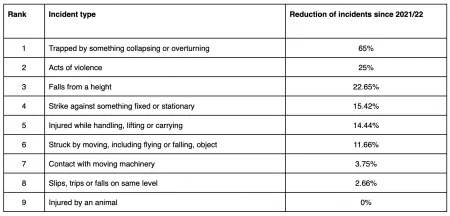
Trapped by something collapsing or overturning – 65% reduction in accidents
Incidents involving being trapped by something collapsing or overturning reduced by 65% in four years, from 20 accidents in 2021/22 to seven in 2024/25. Whilst there has been no major change to regulations, such as the Construction (Design and Management) Regulations 2015, which place responsibility on designers and contractors to identify structural risks during planning and design, incremental changes have been implemented since 2021. Since the Grenfell Tower fire, building safety reforms have been introduced, including the Building Safety Act 2022, which has increased attention to structural risk management.
-
Acts of violence – 25% reduction in accidents
Whilst no major new regulations specifically targeting workplace violence have been introduced, increased use of CCTV, access controls, and workplace monitoring may have contributed to the reduction.
-
Falls from a height – 22.65% reduction in accidents
Accidents involving falls from a height reduced by 22.65%, with 362 accidents occurring in 2021/22 compared to 280 in 2024/25. The aforementioned Building Safety Act 2022 could account for the reduction in falls from a height, as structural risk management has become a focus.
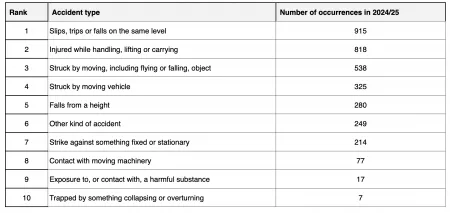
The most common accidents in warehouses in 2024/25
-
Slips, trips or falls on same level – 915 incidents
Slips, trips, or falls on the same level were the most common type of accident in warehouses in 2024/25, with 915 incidents. With 3,754 total accidents since 2021/22, the accident category was the most common in both 2022/23 and 2023/24, with 948 and 951 incidents, respectively. Since 2021/22, there’s been a 2% decrease in slips, trips or falls on same level accidents.
-
Injured while handling, lifting or carrying – 818 incidents
Accidents involving handling, lifting or carrying were the second most common in 2024/25, with 818 occurrences. The category was the most common accident type in 2021/22, with 956 incidents. Since 2021/22, there has been a 14% decrease within the category.
-
Struck by moving, including flying or falling, object – 538 incidents
538 accidents in warehouses involved being struck by a moving, including flying or falling, object in 2024/25, making it the third most common incident. With a total of 2417 accidents in the category since 2021/22, it’s the third overall most common incident to occur in a warehouse.
Richard Thomas at Bureau Veritas says: “While it is encouraging to see a 10% reduction in warehouse accidents over the past four years, the data clearly indicates that incidents are still occurring and must remain a key area of focus. Rather than viewing these events retrospectively, it is more valuable to consider how risks are being identified, assessed, and controlled in real time.
“Creating a safe warehouse environment relies on a proactive risk management approach — ensuring clear walkways, maintaining high housekeeping standards, and equipping employees with the competence to recognise and respond to hazards before they escalate. This is particularly relevant given that the most common type of accident remains slips, trips, and falls on the same level.
“A critical part of effective risk management is the application of the hierarchy of controls. Organisations must prioritise higher-level controls such as elimination, substitution, or engineering solutions, rather than defaulting to administrative measures or reliance on behaviour alone. Across our work at Bureau Veritas, we frequently observe that organisations acknowledge risks but do not consistently apply the hierarchy of controls in a structured and disciplined way. This often results in over-reliance on lower-level controls, which are inherently less effective and more vulnerable to human factors.
“Sustained improvement will come from embedding a stronger risk-based mindset, ensuring that control measures are selected, implemented, and reviewed in line with the hierarchy — ultimately driving more effective and resilient safety outcomes.
“Bureau Veritas supports organisations in meeting their health and safety obligations by embedding a structured, risk-based approach to their operations. We go beyond compliance by helping businesses identify, assess, and control risks effectively, ensuring that control measures are aligned with the hierarchy of controls. Through this approach, we enable organisations to not only demonstrate compliance during inspections and audits but to achieve more robust, sustainable safety outcomes in practice.”
HSM Newsletter
HSM publishes a weekly eNewsletter, delivering a carefully chosen selection of the latest stories straight to your inbox.
Subscribe here