


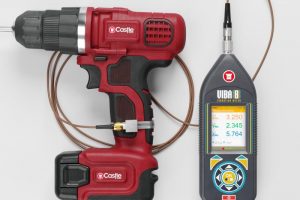
Measuring noise exposure
Simon Bull takes a look at the efficacy of using sound
meters versus dosemeters for noise at work
measurement and whether there is an argument for
using both
To most people, a noise dosemeter
and a sound meter are us
Simon Bull takes a look at the efficacy of using sound
meters versus dosemeters for noise at work
measurement and whether there is an argument for
using both
To most people, a noise dosemeter
and a sound meter are used for
completely different applications,
which can actually mean missing a trick
or two.
The noise at work regulations guidance
(Health and Safety Executive, 2005) says
that you should use a hand-held sound
meter to take short LAeq (Equivalent
Continuous level – a bit like an average)
measurements, which you can then use to
calculate an employee’s daily exposure
(Lep’d) by combining the measurement
from each process or task with the time
that task is carried out for. This can be
tricky with a calculator and pencil, but
there’s plenty of software that will do this
for you once you have the numbers. The
Health and Safety Executive (HSE) also
has a useful calculator on its website that
makes the job simple.
Alternatively, you can use a noise
dosemeter to ‘collect’ the employee’s noise
exposure as they wear it. This can be worn
for an entire shift, meaning that the
number on the screen at the end of the
shift is the exposure figure you can use to
compare with the regulation action levels.
Dosemeters are normally used where an
employee is mobile, such as forklift
drivers or maintenance operatives, and
where making hand-held measurements is
difficult to say the least.
Discovering the differences
There are, of course, problems with both
of these methods. If you are using a handheld
sound meter, you are only taking
short measurements (it should be a
minimum of at least five minutes
wherever possible) and then you are
estimating an eight-hour exposure figure,
so the potential for error is quite large if
you didn’t capture the ‘representative’
noise levels. As for dosemeters, there can
be problems with workers abusing the
instruments and there are potential errors
from reflections of the sound bounding
off the wearer’s clothing.
There are other differences that are not
so obvious at first glance, according to Liz
Brueck of Health and Safety laboratories
(Brueck, 2012). In her 2012 study, she
took multiple sets of sound meter and
dosemeter readings and correlated them
to determine potential differences. In the
case of the LAeq readings, the dosemeter
results were actually lower (not necessarily
what you’d expect), which has been put
down to
wearers of
dosemeters
spending
some of their
time in quiet
environments,
whereas the sound
meter operative
only measured
the higher
events.
This shouldn’t be a problem in itself as the
calculation of exposure should take into
account the time spent in the noise. There
was also a smoothing effect, which
effectively hides the detail of noisier sites
or areas, so this should certainly be
investigated with a sound meter.
The peak readings were the other way
round, with the dosemeters reporting
higher levels. The most likely cause for
this is that dosemeter wearers are
uncontrolled and could pick up unwanted
sounds from accidental (or deliberate)
tapping of the microphone, or proximity
to disturbance such as air-line exhausts.
The study did find that general movement
of clothing or activity by the wearer didn’t
significantly affect the results.
So what to do for the best?
The first thing to look at is to make sure
that your dosemeter readings are at least
free from deliberate messing about (with a
new ‘toy’ comes the temptation to play
around with it). The best way to overcome
this is to use it more! If you own a
dosemeter, then it should really be in use
– even if you don’t note the readings all
the time. With increased measurements
you will increase the reliability.
Then you should consider the peaks
you’re getting. If the dosemeter is
suggesting you don’t have a problem, and
bearing in mind that they tend to overreport,
then you can be confident that you
don’t. If you’re not sure, or if the results
are on the borderline, then these should
be checked with a hand-held sound meter.
In essence, when you look at the data,
you really should be doing both; clearly,
using a hand-held meter to estimate the
exposure should give you a very similar
result to using a dosemeter. If the results
are completely different, then you may
need to think again. I’m not suggesting
you do this every time as you’d end up
doing nothing but measuring noise.
Certainly, if you were to carry out this
check once in a while, you would have a
very good case for backing up the
integrity of your measurements and
putting the results that bit further from
challenge.
Simon Bull is managing director of
Castle Group, safety and environmental
compliance specialists.
Related posts

HSM Newsletter
HSM publishes a weekly eNewsletter, delivering a carefully chosen selection of the latest stories straight to your inbox.
Subscribe here