

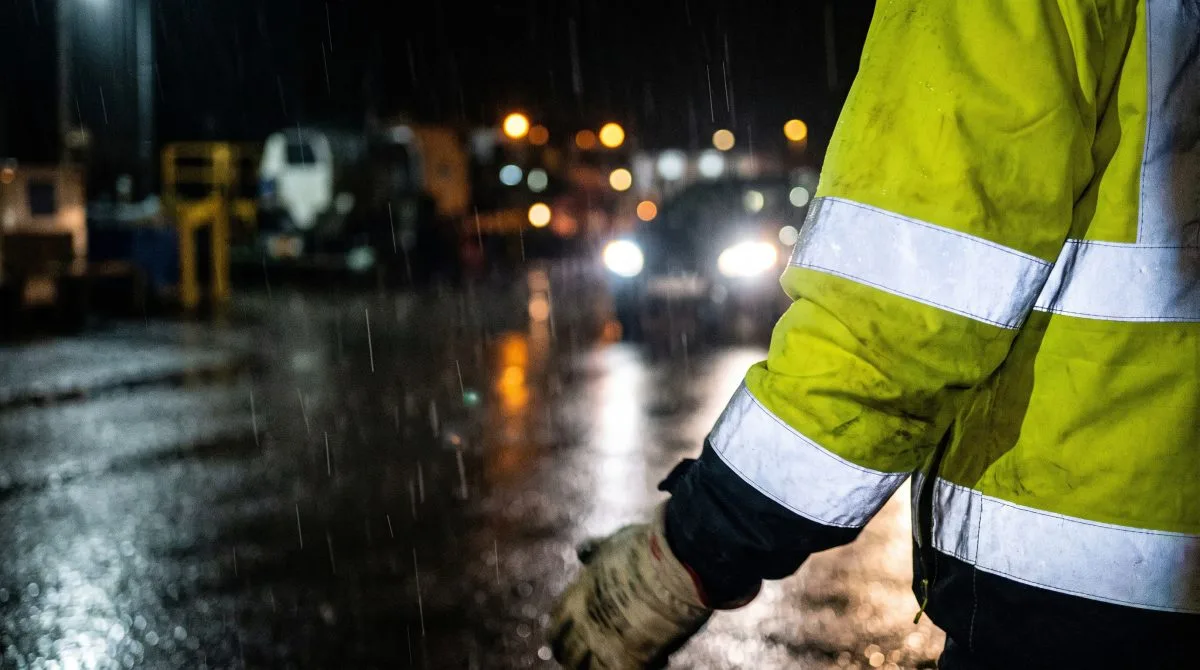
Hi-vis requirements and failures
OUTDOOR WORKERS get harder to see from late September onwards. Low sun, fog, heavy rain and early darkness all cut the distance at which someone is visible, and the change is gradual enough that nobody marks the day it starts to matter. But the risk is not abstract.
Being struck by a moving vehicle is the second most common kind of fatal accident at work in Great Britain, with HSE’s provisional figures for 2025/26 recording 24 deaths against 31 from falls from a height.
Most duty holders check that their teams have hi-vis. Far fewer check whether it still works. The problem is that high visibility clothing wears out quietly, in ways that are easy to miss on a garment somebody puts on every morning without thinking about it. It fades. The reflective tape cracks and lifts, and sooner or later someone pulls a fleece over the top of it. Personalised hi vis clothing suffers most. It is usually the oldest kit on site, because nobody bins a jacket they paid extra to have branded, and a logo does nothing to slow the fading.
A faded jacket is rarely a problem in June. It becomes one between late September and March, when the same garment has to work in fog, heavy rain and darkness. EN ISO 20471 sets the bar every hi-vis garment has to clear. Knowing what that bar involves is where any useful check starts.
What EN ISO 20471 actually requires
EN ISO 20471 is the standard for high visibility clothing worn in higher risk work. It replaced an older standard, EN 471. In simple terms, it sets out how much bright material a garment needs, where that material has to sit, and how all of it gets tested.
Two materials do the work, and they do different jobs. Fluorescent fabric is the bright yellow or orange you can pick out from a distance in daylight, including the flat grey light of a British autumn. Retroreflective tape is the silver banding. It bounces light straight back towards whatever produced it, which is what makes a worker show up in headlights.
You need both, because each one fails at a different time of day. Fluorescent fabric does almost nothing once the light has gone. Reflective tape does almost nothing at midday with no headlights to bounce back. A compliant garment carries enough of each, positioned so the wearer can be seen from any direction. Visibility from behind matters most, because that is the one approach the worker cannot watch for.
Looking bright is not the same as being compliant. A jacket can be vivid and still fail. Certification measures exact colour values, exact areas of material and exact placement, and it applies to one particular garment as it was made. A brand name is not certification that your hi vis is compliant.
How many classes of high visibility clothing are there?
There are three classes of high visibility clothing. The class depends on how much fluorescent fabric and reflective tape the garment carries, and it is printed on the label next to the standard reference. More material means a higher class and better visibility.
Choosing between them is a risk assessment rather than a preference. Look at the site, the light, the vehicles moving nearby and the job being done. Then write the reasoning down. Repeating last year’s order is not a risk assessment.
Class 1 high visibility clothing
Class 1 carries the least material of the three. It generally suits quieter sites away from public roads, where vehicles are few and slow. For roadside work or dark winter shifts, it is the weakest option on the shelf.
Class 2 high visibility clothing
Class 2 sits in the middle, and it is the one most teams are issued with. You will see it across warehousing, distribution, grounds maintenance and a great deal of construction. Most standard waistcoats and lighter jackets fall into this class.
Class 3 high visibility clothing
Class 3 hi vis gives the highest level of visibility of the three. Reaching it normally means bright material and reflective tape across the upper body and down the sleeves, so a plain sleeveless waistcoat cannot be Class 3 on its own.
Two garments can add up to it together. A Class 2 jacket worn with hi-vis trousers may reach Class 3 as a set, but only where the manufacturer says the combination works. Check the label. Mixing brands and hoping for the best is how teams end up a class short without ever realising.
When is class 3 high visibility clothing required?
There is no single rule that names a class for every job. It comes down to the risk assessment, and the usual triggers are fast moving traffic, poor light and long sight lines. Higher speeds and darker conditions push you towards Class 3.
Class decisions are worth revisiting as the seasons change. A role assessed in June, in full daylight, might sit comfortably at Class 2. The same role in December, finishing after dark next to moving machinery, may not.
Three ways compliant hi-vis stops being compliant
It may never have been compliant
The most uncomfortable possibility is that a garment never met the standard in the first place. In recent market surveillance, the British Safety Industry Federation tested 88 PPE products bought from suppliers outside its Registered Safety Supplier Scheme. Only 18% met every requirement. Among the hi-vis jackets in that sample, 84% failed on brightness and visibility.
Not all of those failures were about performance. UK rules also require valid certification and correct marking, so a product that turns up without a Declaration of Conformity is non-compliant whatever it does under test. Paperwork counts as much as fabric.
Guarding against this is simple enough. Buy hi vis ppe from suppliers who can show you what they are selling. Ask for the certification covering that exact garment rather than the range it sits in. Ask for the Declaration of Conformity, the class, and the care label stating how many washes the garment was tested to.
It has worn out
Hi-vis has a working life, not just a purchase date. Fluorescent fabric fades in sunlight and in the wash. Reflective tape cracks, stiffens and eventually peels away from the fabric underneath. Both happen slowly, which is exactly why nobody spots them.
The standard deals with this by testing garments after cleaning, and manufacturers then print a maximum number of washes on the care label. Almost nobody counts. A jacket washed every week for eighteen months may be well past that figure while still looking fine to the person wearing it.
It is being covered up
The third failure is the most seasonal, and the most human. It gets cold, so people put another layer on, and a fleece over a certified waistcoat cancels out the whole thing. Bulky jumpers underneath cause bunching that folds the reflective bands out of sight. Badly fitting hi-vis is a visibility problem, not just an uncomfortable one.
Damage and dirt do the same job more slowly. Rips cut into the certified areas and can snag on moving parts. Ground in dirt on fluorescent fabric dulls it in daylight, which is why regular washing is a safety job rather than a cosmetic one.
How often should you replace high visibility clothing?
Replace a garment when it hits the wash limit on its label, when the fluorescent fabric has visibly faded, or when the reflective tape is cracked, lifting or torn. Whichever comes first is your trigger. Inspect garments when they are issued and at set points afterwards.
Spotting the fading is easier than it sounds. Keep one unworn garment of each model in the store and hold a used one against it. Side by side the difference jumps out, where a single garment gives you nothing to judge against.
Layering for autumn and winter without losing visibility
Cold weather sets warmth against visibility, and warmth usually wins. Telling people not to put a coat on rarely works when they are freezing. The answer is to make the warm layer the compliant one.
Hi-vis fleeces, softshells, insulated jackets and waterproofs are all made to the standard. Choose one of those and the certified garment stays where it belongs, on the outside. If you are keeping a base hi-vis garment instead, size it to go over the layers rather than under them.
Adding reflective tape to an ordinary jacket does not work either. Certification covers the garment exactly as it was tested, so anything stuck on afterwards falls outside it.
Adding logos and branding to hi-vis
Branding hi-vis is normal and often necessary. It identifies contractors on a shared site, marks out supervisors and marshals, and helps control who is where. The part that gets missed is that adding a logo changes the garment itself.
The class depends on how much fluorescent fabric and reflective tape the garment carries. A logo printed over fluorescent fabric reduces the first. A logo running across the silver banding interrupts the second. Enough of either and the garment quietly drops below the class on its label, so you end up issuing Class 2 protection into a Class 3 job without anyone deciding to.
Settle the logo placement before production, not after. Any personalised workwear supplier should send you a visual proof first, showing exactly where the logo will sit and how big it will be. A proof takes minutes to check and prevents a problem that might otherwise go unnoticed for years.
The method matters too. Embroidery, heat applied transfers and printed film all behave differently on technical fabrics and under heavy washing, so the right choice depends on the garment, the logo and how often it gets cleaned. A good supplier will tell you which one suits. None of this is reserved for big orders either, because there is no minimum quantity below which proper proofing stops being worthwhile.
What to look for in hi vis workwear brands and suppliers
Established manufacturers make checking easier, because they publish certification and class information for each garment rather than for a range. Brands including Portwest hi vis workwear, Blaklader, Mascot, Helly Hansen and Leo Workwear all work this way. Product level documentation is a fair thing to expect from any of them.
The supplier matters as much as the manufacturer. A good one will confirm the class of a specific garment, produce its certification without fuss, advise on the right class for the site you describe, and proof any branding before production starts. None of those four requests is unreasonable.
The check worth doing before the clocks go back
The check itself is not a big job. Pull a handful of the high visibility garments actually in use, not the clean stock sitting in the store, and read the labels for class, standard and wash limit. Check the fluorescent fabric for fading. Check the tape for cracking and lifting.
Then look at what people are genuinely wearing, because it is often not what the risk assessment assumed. Finally, check whether any branding added since purchase has eaten into the certified areas. Those four checks will find most of the hi-vis that has stopped working, and doing them in early autumn leaves time to replace whatever fails.
HSM Newsletter
HSM publishes a weekly eNewsletter, delivering a carefully chosen selection of the latest stories straight to your inbox.
Subscribe here