


Getting glove specification right
WHEN IT comes to the supply of PPE for hundreds, or thousands of operatives at a time, it can easily become a tick-box exercise; a procurement decision rather than a safety-critical one.

With hand injuries consistently ranking along the most frequently reported workplace injuries in the UK, it may be time for Health & Safety leaders to step back and review how they specify, select, and implement hand protection. The knock-on effects of hand injuries; operative downtime, insurance claims, rising premiums – carry significant cost for the business as a whole

The reality is that specifying the right glove for a task requires a structured, evidence-based process. It starts with understanding the risks posed, interpreting the standards that refer to protection levels, and matching glove performance to the exact demands of specific tasks. Done well, it reduces injuries, lowers costs, and builds a safety culture where workers trust the PPE they’re given. Done poorly, it erodes trust, reduces compliance, and increases the very injuries it was meant to prevent.
This guide will walk you through the key considerations every safety manager, procurement lead, or Health & Safety professional should work through when specifying hand protection.
Start with the risk assessment
Accurate specification is impossible without first establishing:
- What hazards do workers face?
- How severe is each hazard?
Mechanical hazards like cuts, abrasion, punctures and tears, are the most common in construction and infrastructure environments. Hazards such as chemical hazards require a different set of considerations entirely due to the variety of substances handled across different industries, sites, and tasks. For these, the key questions are:
- What substance is present?
- What is the concentration of the substance at hand?
- How long are operatives exposed to the substance at a period of time?
- Which glove material will provide the best protection against said substance?
A task-by-task assessment is essential. Operatives in the same team could be facing different risks depending on what they are doing at any given moment. A common pitfall is choosing the highest possible level of cut protection without considering usability. Different tasks not only require varying levels of cut protection, but also dexterity and grip, amongst other features. A single all-purpose glove rarely covers everything – which is precisely why detailed task-risk analysis must come first.
Understanding the standards
A working knowledge of the relevant standards is genuinely useful when matching hand protection to specific tasks. The core standard is EN388, which measures a glove’s resistance to:
- Abrasion
- Cut
- Tear
- Puncture
The easiest way to remember this is ACTP (Abrasion, Cut, Tear, Puncture).
In 2016, EN388 was updated to improve cut testing. A new test (ISO 13997) was added because the old test could give misleadingly higher scores for gloves that dull the blade during testing. Now, you will see a letter after ACTP (3 1 4 1 A) which denotes the result from the new cut test. Often you will see an “X” where the gloves weren’t tested to the old cut test (3 X 4 1 A).
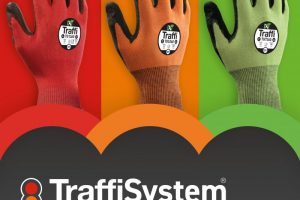
This can be confusing, which is why Traffi introduced the simple 3-colour TraffiSystem: a simple three-colour coding that maps directly to cut level:
- 🔴 Red — Cut Level A
- 🟠 Amber — Cut Levels B–C
- 🟢 Green — Cut Levels D–F
For health and safety managers and operatives alike, it provides an immediate, intuitive way to identify the right protection for the task.
Specifying hand protection that operatives want to wear
Traffi understand that the protection level is only part of the equation. Gloves that operatives refuse to wear due to discomfort, lack of dexterity or incorrect sizing, will offer no protection at all.
A robust specification process should always consider:
- Fit and sizing across a diverse workforce
- Dexterity required to complete tasks efficiently
- Grip performance in relevant conditions
- Comfort and ergonomics

Modern materials and yarn technology have moved the industry a long way from the days when ‘safer’ meant bulkier. High dexterity and outstanding cut protection can now coexist. The practical approach is to specify the minimum protection level that addresses the hazard and prioritise gloves that operatives will wear consistently.
Sizing is a particular challenge when specifying for an entire workforce. One size does not fit all. Individuals should have the opportunity to identify their correct size and assess the fit and feel for themselves — worker buy-in is essential to achieving the safety objectives set at the outset.
Grip requirements also vary by task. Wet or oily conditions demand coatings specifically engineered for those environments; gloves that perform well in dry conditions can become a hazard when grip is needed most.
Conducting wearer trials across the workforce before committing to a specification is something that every safety manager should coordinate. Taking this step early helps prevent wasted time and spend on gloves that workers don’t want to wear.
Building a specification
Once risks are assessed, standards understood, and wearer compliance confirmed, the programme can then be rolled out. Each task should have a clearly assigned glove, communicated simply and consistently across the workforce. Ongoing monitoring and feedback loops ensure the solution continues to perform — and adapts as risks evolve.
Take the next step: Free glove audit and user trials
Traffi offers a complimentary Glove Audit for health and safety teams who want an honest, expert assessment of their existing hand protection programme. We’ll review your current specification against the risks your operatives actually face, identify any gaps in protection or compliance, and recommend a structured path forward.
We also run hands-on user trials, putting the right gloves in the hands of your workforce before any commitment is made. It’s the most reliable way to validate protection levels, confirm fit and comfort across your team, and secure the operative buy-in that makes a specification stick.
Both services are free, practical, and are designed to make your job easier.

Ready to review your hand protection programme? Book your Glove Audit today: www.traffi.com
Related posts

HSM Newsletter
HSM publishes a weekly eNewsletter, delivering a carefully chosen selection of the latest stories straight to your inbox.
Subscribe here