



Night vision
NIGHT SHIFTS operate under unique pressures — reduced staffing, limited supervision and slower response times — creating hidden safety risks that demand closer attention. Jeremy Michaels provides an insight.
Facilities managers can usually describe their safety culture in detail. There are structured briefings at the start of the shift, visible leadership throughout the day, peer reinforcement on the floor and established reporting lines when something goes wrong. On paper, it is coherent and well supported. But ask what happens at 2.00am on a Sunday and the answer is often less certain.
The night shift in any 24-hour operation runs under different conditions. Staffing levels are lower. Supervisors may be responsible for wider areas. Senior managers are rarely on site. Response times are longer. The environment itself may even feel different. Quieter. More isolated. Less observed.
None of this means standards disappear overnight. Policies still apply and procedures still exist. Yet many safety systems are designed around assumptions that hold true in daylight hours: visible oversight, immediate support and a constant flow of informal correction. When those elements reduce, the character of risk begins to change.
What changes after dark
During the day, safety is constantly reinforced. People spot issues, challenge them, and fix them quickly, often before they become a problem. At night that informal layer thins. Fewer people cover more space, supervisors are stretched, and small deviations are less likely to be noticed or challenged in the moment. This is where safety can quietly shift from active to passive.
Most night shift risks do not arrive as dramatic events. They arrive as small, practical compromises. A door gets wedged for convenience. A walkway becomes temporary storage. A manoeuvre is completed without a spotter because there is nobody free. If nothing bad happens, the workaround starts to feel acceptable. Over time it becomes normal, and that is when the risk can harden into its own “new” process.
Response capability shifts overnight. First aiders, wardens, and decision-makers are less accessible, and support is more dispersed. A delay of ten minutes is rarely the root cause of an incident, but it can change the severity of what follows.
In night operations, you are often running with less redundancy. When something does go wrong, recovery is slower.
When incidents go unseen
The night shift produces a data gap. Near misses are less likely to be witnessed, logged, or escalated. CCTV footage exists, but it is seldom reviewed unless there is a serious incident. That means safety dashboards can look healthy while risk patterns quietly persist in the background.
The instinctive response is to add controls: more checklists, more audits, more reminders. But extra rules increase the burden on smaller teams and do not restore the missing ingredient, which is real-time visibility. Audits also tend to happen during the day, so they measure the most observable shift, not the least.
The underlying challenge is visibility, not intent. How do you maintain active safety oversight when physical presence is limited?
Introducing technology to extend oversight
This is where the conversation shifts from passive monitoring to proactive prevention. Traditional CCTV is designed to records events so they can be reviewed later. In safety, that often means learning arrives after harm.
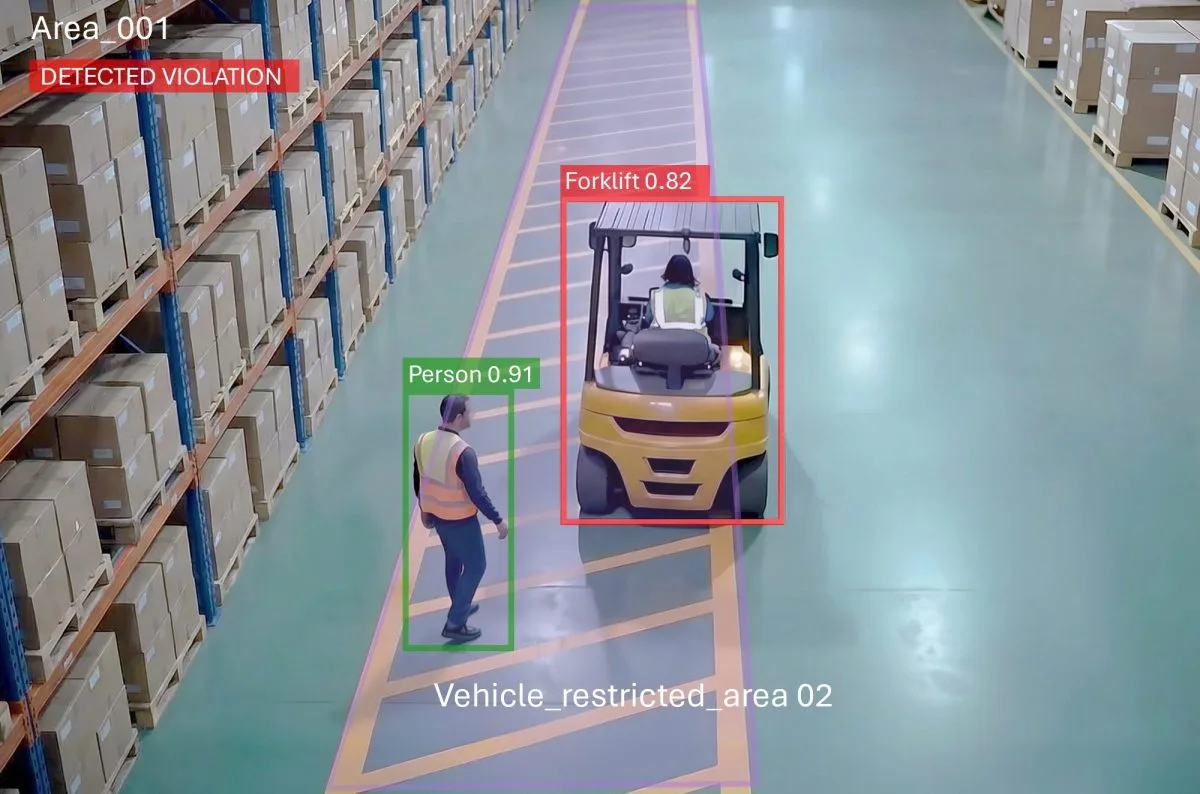
Computer vision changes the role of cameras from passive recorders to active safety controls. Instead of simply storing footage, systems analyse live video streams in real time and detect predefined risk conditions as they occur. When a threshold is breached, an alert can go to the right person immediately, on site or remotely.
In practice, computer vision becomes a coverage multiplier for both day and night shifts. It helps a small team operate with clearer guardrails, without expecting somebody to be everywhere at once.
Seeing risk
The best deployments start with repeatable, high consequence risks. Not everything, just the conditions that tend to drift on nights when oversight is thin. Below are seven examples from deployments and the impact of computer vision.
- Emergency exits and egress routes
Flags blocked exits, encroached walkways, and obstructed muster points so the team can clear them before “temporary” storage becomes the night shift norm.
- Fire safety controls
Detects fire doors left open beyond a set time, missing extinguishers at fixed points, or unauthorised entry around hot work areas where small breaches can escalate quickly.
- Vehicle and pedestrian separation
Monitors entry into forklift zones and proximity events in bays and intersections, giving evidence to fix routes, signage, and barriers where near misses cluster.
- Speed and manoeuvring behaviours
Identifies speeding in defined risk areas, unsafe reversing patterns, and repeated failures to stop at internal control points, reducing high energy incidents and damage.
- PPE compliance in defined zones
Where agreed, checks for required PPE in specific areas, supporting consistent compliance without constant manual policing across the whole site.
- Housekeeping and slip-trip controls
Spots spills, trailing hazards, blocked access routes, and unsafe stacking in priority walkways so issues are dealt with before they become a familiar night problem.
- Lone worker and ‘man down’ indicators
Looks for a person on the floor or unusual inactivity in remote spaces, helping trigger faster checks when individuals are working with limited backup.
These are the issues that keep reappearing in investigations. The difference overnight is speed: hazards are surfaced while they are still easy to correct.
Computer vision at night
Night shift safety is a visibility challenge. When alerts go to a supervisor or remote team in the moment, standards stop depending on who happens to walk past. Exceptions get handled, logged, and learned from, rather than becoming part of the routine.
It also avoids the CCTV trap of screen watching for hours. Attention goes to the handful of events that actually need action. For many teams, the biggest shift is that conversations move from opinion to evidence. You stop debating whether exits are “often” blocked at night and start fixing the locations and routines that cause it.
Hence deploying computer vision can lead to a number of beneficial outcomes.
- Fewer incidents and near misses
Fewer vehicle pedestrian conflicts and fewer repeat hazards, reflected in reduced recordables, first aid cases, and close calls.
- Reduced downtime and disruption
Earlier intervention means fewer stoppages, fewer investigations, and less knock-on delay, especially where dispatch windows and throughput are tight.
- Lower cost exposure
Reduced claims frequency and severity, lower damage to racking and equipment, and a stronger position on compliance where enforcement is increasing.
- Better audit readiness and evidence
Time stamped events and corrective actions show whether controls work at 2.00am, not just during the day shift walkaround.
Ease of deployment
Computer vision does not need a long transformation programme if you start small and keep it operational.
Step 1: Use existing cameras where possible
Most sites already cover bays, exits, and main routes. Connecting to those feeds reduces cost and speeds time to value.
Step 2: Pick two or three priority risks
Start with the hazards most likely to drift at night: egress, fire doors, and vehicle pedestrian separation are common.
Step 3: Define zones, thresholds, and alert routing
Set the rules (door open time, keep clear zones, speed areas) and decide who gets notified, how it escalates, and how events are reviewed.
Step 4: Tune quickly, then operationalise
Calibrate to avoid alert fatigue, then embed it into shift routines: who responds, what gets logged, and what triggers a layout or process change.
Done well, with a step-by-step approach, teams can deliver early wins, then scale without rewriting the playbook.
Multi-site safety layer
Many organisations trial one camera and one alert. Once cameras are connected and governance is agreed, adding capabilities becomes a configuration step, not a rebuild.
Extend blocked exits to blocked walkways in the same zone. Roll fire door timing across every door. Expand vehicle pedestrian detection from loading bays to internal intersections. Add targeted PPE checks only where risk demands it. Introduce spill and housekeeping alerts in known high slip areas. The benefit is consistency. The same standards can hold when the building is full and when it is quiet.
If you run several warehouses or plants, the hard part is not policy. It is making controls real across different layouts, teams, and shifts.
A platform approach helps by standardising the baseline rules (exit clear, doors closed, traffic separated) while allowing local tuning. It also enables central benchmarking: which sites have recurring night shift hotspots, and which fixes travel well. And once one site is live, the next deployment is faster because the operating model is already defined.
Stress test of safety design
For premises managers, the night shift is the clearest stress test of safety design. If controls only work with high staffing and visible leadership, they are fragile. If they still work when oversight is thin and response is slower, they are resilient.
Computer vision supports that resilience by closing the visibility gap. It helps teams spot hazards early, keep standards consistent, and learn from patterns that would otherwise stay hidden after dark. When safety remains active at 2.00am, it becomes stronger at every other hour of the day.
Jeremy Michaels is strategic content writer at viso.ai. For more information, visit www.viso.a
Related posts

HSM Newsletter
HSM publishes a weekly eNewsletter, delivering a carefully chosen selection of the latest stories straight to your inbox.
Subscribe here