



Understanding the dangers of silica dust
Matthew Judson of JSP considers the precautions that construction
workers should take to protect themselves from silica dust
The effects of inhaling dust from
silica, a very common mineral
that occurs naturally in man
Matthew Judson of JSP considers the precautions that construction
workers should take to protect themselves from silica dust
The effects of inhaling dust from
silica, a very common mineral
that occurs naturally in many
materials found or used on construction
sites, should never be underestimated,
just because they may take many years to
manifest themselves. Breathing silica
dust can be life-threatening and
devastating for construction workers,
who are at increased risk of developing
silicosis, lung cancer and other serious
lung diseases such as chronic obstructive
pulmonary disease (COPD) and
tuberculosis (TB). Silicosis is incurable,
since silica particles lodge in the lung
tissue, causing fibrosis (permanent
scarring), severe shortness of breath and
a chronic cough that may also be
accompanied by chest pain, fever and
weight loss. Many hundreds of
construction workers die each year from
exposure to silica dust.
Silica has two forms, crystalline and noncrystalline.
The very fine dust from the
crystalline form found in sand, sandstone,
quartzite, slate, gravel, clay, granite and
other types of rock is the most dangerous
to human lungs and is known as
respirable crystalline silica (RCS).
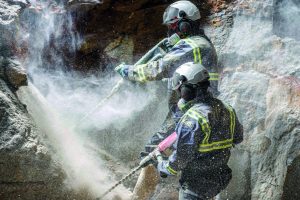
Common materials used by construction
workers containing silica including bricks,
tiles and concrete put them at risk of
exposure to RCS when using tools such as
drills, grinders, saws, sanders, sand
blasters, cutters and concrete mixers, or
even brooms and shovels. Workers are
especially vulnerable to smaller airborne
silica particles, which can be inhaled deep
into the lungs where they cause
irreparable damage.
So what can be done to protect workers
from the potentially damaging effects of
silica dust on construction sites? Using
less hazardous materials, isolating the
activity, ventilating the area where work
takes place on silica, removing dust by
vacuuming and using local exhaust
ventilation systems, and suppressing it by
spraying water, are all good options for
controlling the dust, but they are not
enough on their own and cannot always
practically be put in place. Well-fitting,
appropriate, comfortable, respiratory
protective equipment (RPE) should also
be provided and workers trained in its
correct use and maintenance to prevent
them from breathing the dust that
inevitably becomes airborne despite these
other measures.
The law
Several pieces of legislation are concerned
with silica dust. In 2006, RCS was
assigned a new maximum exposure limit
(MEL) of 0.1 mg/m3, (reduced from 0.3
mg/m3) expressed as an 8-hour time
weighted average. Activities which may
expose workers to silica are subject to the
Control of Substances Hazardous to
Health Regulations 2002 (COSHH),
which require the health risks from silica
to be assessed and then prevented or
controlled. Fit testing of tight fitting
respiratory protection is also mandated
under these Regulations. In the European
Union, the selection and use of
respiratory protection comes under the
2005 Standard EN 529, which obliges
employers to put in place both suitable
RPE and training in its correct use, fitting
and maintenance.
Fit-testing
Providing RPE that does not fit the wearer
properly can be more dangerous than
them not wearing any protection, since it
may give a false sense of security. Since
the quality of fit-testing in the past has
not been adequate and it has often been
carried out incompetently, Fit2Fit (Fit Test
Providers Accreditation Scheme) was
launched by the BSIF in 2009, focusing on
raising the quality of fit-testing in the UK.
In their current ‘Clean Air – Take Care’
initiative, the HSE and BSIF are advocating
fit testing of respirators to overcome their
often ineffective use in the workplace.
According to the HSE, there are 12,000
deaths every year from respiratory diseases
caused by occupational exposure,
including silica. One of the HSE’s
particular concerns is incompatible PPE
and the fit testing of combinations of PPE
that are normally worn at the same time,
such as disposable masks and safety
eyewear, because fit test results may
become irrelevant when different eye and
respiratory PPE are used together.
JSP’s innovative FilterSpec, and
FilterSpec Pro (a version suitable for
power tooling incorporating goggles),
combine independent eye and respiratory
protection to work in harmony with
maximum effectiveness in one integrated,
compatible unit that helps to address the
challenge of fit and satisfy the HSE’s
concerns over the quality of the fit. The
combined PPE solution solves many of
the problems, with high quality P3 level
filters, face fit compliance, fog free vision
and a comfort that will encourage
responsible use.
Using sensible precautions will help
ensure that silica dust does not become
the new asbestos in 20 years’ time.
Related posts

HSM Newsletter
HSM publishes a weekly eNewsletter, delivering a carefully chosen selection of the latest stories straight to your inbox.
Subscribe here