


You can’t manage what you don’t measure
The management of the many potentially dangerous
physical and chemical agents found in workplaces can
be a daunting task. Neal Hill and Tim Turney of Casella
Measurement offer some pointers on where to start
In their
The management of the many potentially dangerous
physical and chemical agents found in workplaces can
be a daunting task. Neal Hill and Tim Turney of Casella
Measurement offer some pointers on where to start
In their web article Choosing the right
noise exposure assessment tool,
(www.phaseto.com) David S. Cmar
and John A. Rioux state that the chosen
strategy depends on many circumstances;
the matrix reproduced below summarises
the available tools for noise exposure
assessment (but this equally applies to
agents other than noise).
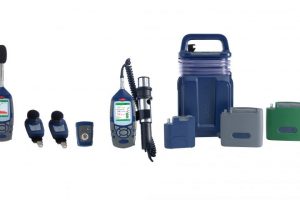
Area monitoring refers to the use of a hand
held (sound level) meter, while (noise)
dosimetry allows a bodily worn instrument
to measure across a full shift (FS), which
can be targeted at certain ‘mobile’ workers
and offers a compromise in terms of cost
and complexity. The task based (TB)
concept involves an exposure being
calculated based on a breakdown of the
elements a person typically performs. This
means making assumptions about the tasks
performed and typical time ‘on task(s)’
combined with a noise level based on a
sample of each individual task.
Consequently this approach can be both
costly and complex but software packages
exist to help the process.
Clearly, the same method used in a
small engineering shop would not be
relevant to a mining operation employing
thousands of miners. Mining is a good,
albeit extreme example, of simultaneous
exposure to several agents i.e. gas, noise,
vibration, temperature & humidity. The
mining sector have highly developed
regimes for near continuous sampling of
noise and dust exposure to ensure
statistical validity (as highlighted in the
matrix). The construction sector is another
example and studies have been undertaken
comparing FS measurements and TB
assessments with varying degrees of
correlation.
Many instrumentation vendors see
themselves just in the measuring business
and tend to be ‘vertical’ in nature,
specialising in just one discipline. By
contrast, companies such as Casella
Measurement provide a complete solution
for workplace assessment across a range of
physical and chemical agents. This has
been facilitated in Casella’s case by its
investment in Casella Insight data
management software.
Rather than using several software
applications to download from many
instruments, Casella Insight allows data
from a range of supported instruments to
be downloaded and stored into one
versatile package. Data is stored on a
centralised database which may be
managed by Person, Place or Process
criteria. Data can be viewed in tabular or
graphical format and analysed as necessary.
When an instrument is connected to
Casella Insight, it automatically downloads
stored data. Casella Insight manages all the
instrument’s re-calibration dates and gives
notification when they are due, as well as
storing the actual calibration certificates.
Users of existing Casella CEL software
packages e.g. dB35 can import previously
downloaded data. While data within
Casella Insight can easily be exported and
sent to other colleagues or users, allowing
data to be shared easily across larger
organisations
Exposure levels can be colour coded by
a simple ‘traffic light’ system, making it
easy to see which individuals or locations
exceed action levels. These limit values can
be user defined if a more stringent action
value is desired. Graphs can be further
analysed by adding zones which
subsequently provides exposure levels,
inside and outside these zones. This allows
the exclusion of extraneous events, breaks
and so on to provide comparative
exposure calculations. Any exclusion zones
added to data are retained with the data file
and shown on reports.
A simple ‘tree view’ can be created with
which to store and manage data by Person,
Place or Process since, once data has been
downloaded, files can be ‘dragged and
dropped’ to the relevant tree location and
all data subsequently stored within a central
database. This is together with any notes
and information added by the user about
the measurement and mitigating actions for
the employee. Templates are provided to
view data, which can be further customised,
displayed and reported as simply or as
comprehensively as required.
Reports can be stored in multiple
formats (e.g. .pdf, .jpg, or .csv) allowing
them to be shared and viewed easily, as
well as exported to other applications.
In addition exposure data from
multiple agents may be viewed and
reported simultaneously and being able to
correlate noise and dust exposure is
advantageous to those tasked with process
improvement aimed at minimising
exposure.
Casella Measurement’s vision is one of
a complete solution to monitoring
exposure of companies’ employees for a
range of occupational hazards. Casella
insight software allows this by providing
the ‘answer’ in terms of exposure levels
without the need for indepth analysis,
saving time and effort for the health &
safety professional in today’s multitasking
world where it is remains undeniably true
that you “can’t manage what you don’t
measure”.

HSM Newsletter
HSM publishes a weekly eNewsletter, delivering a carefully chosen selection of the latest stories straight to your inbox.
Subscribe here